PS: Please don’t read this article if you are highly sensitive to religion.
This article is more about personal choices regarding religion than religion itself.
There are some atheists; they dislike religion so much that they can’t visit religious places even for the sake of observing the beauty of the structures. Then there are people who do not really care whether god exists or not. They may believe that god does not exist, but they won’t stop themselves from visiting the religious places to enjoy the beauty, history, and aesthetics of the places.
I was talking to a friend who mentioned that someone in his library gave him a small poster with ‘Radhe Radhe‘ written on it to stick it in front of his desk. He stuck the poster for the sake of giver’s happiness. The neutrality about religion is such that it doesn’t matter what is written on the poster, if it gives someone close to them some pleasuree, they do it.
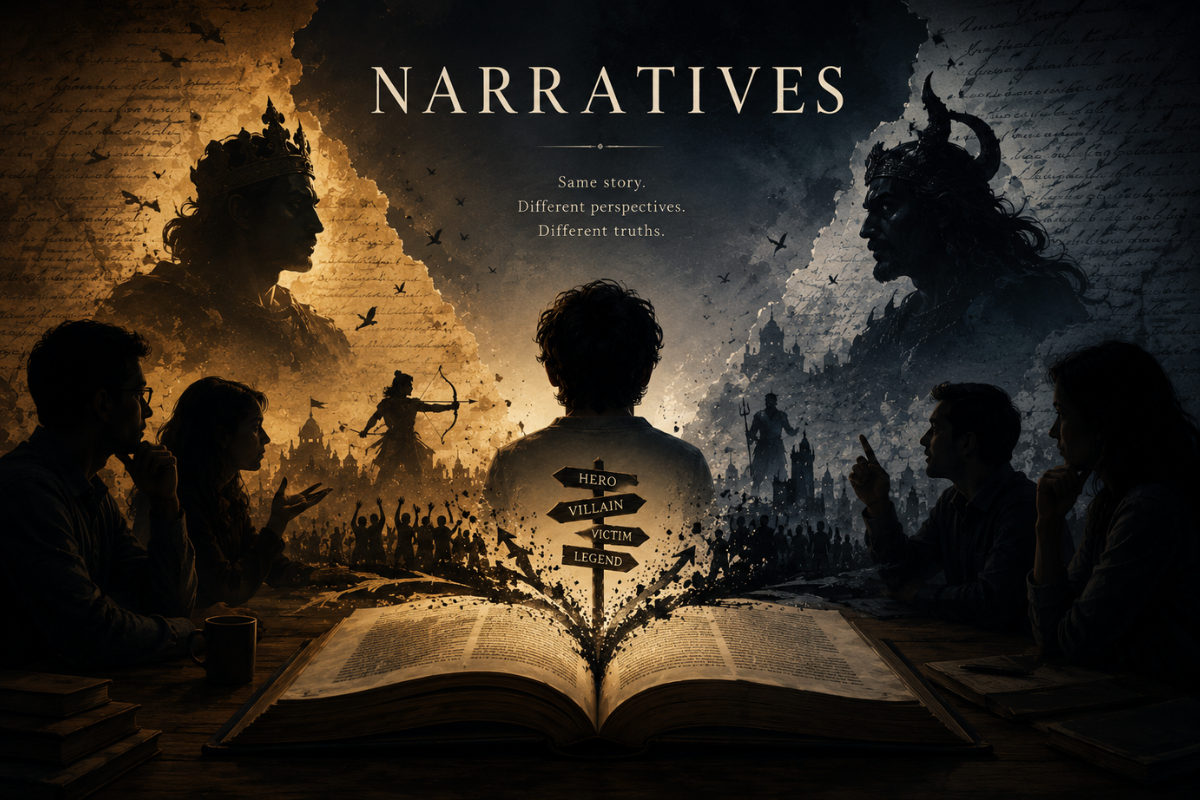
Then came the thought, suppose someone gives him, or anyone of this kind, a poster on which ‘Ravana‘ is written. Would they still paste it with the same sense of neutrality? Or would morality suddenly become important?
We know there are various versions of ‘Ramayana‘ and in some of them ‘Ravana‘ has been shown in good light. I have not personally read those versions, so I can’t comment deeply on them. But considering the popular version, the basic fact is that ‘Ravana‘ was evil.
Now comes the question.
Can the Ramayana truly be considered history?
The Ramayana can be considered history only if we truly accept that gods exist, and there are all forms of gods, and various gods, and they live wherever they are mentioned to be living. Like Mount Kailash in the Himalayas, but considering the fact that there’s no one on Kailash proves or at least indicates that no one lives there. Yeah, it’s true that no one has ever reached there, but it’s more due to its cultural and religious taboos than terrain.
But if someone wants to consider Ramayana as a history, then they need to stop their minds from using LOGIC for that part. The moment gods are treated as beings actually living somewhere, various questions arise, like what do they do all day. I don’t need to tell you the WHY of it. Do I?
Let me narrate some things to validate this point. How do you say that monkeys and bears can help any human in their war against some Demons, considering the fact that demons are powerful, as each of them has supernatural powers, and they can do anything, but monkeys and bears cannot.
How do you justify the Pushpak Vimana? I mean the kind of technology it was using, it can never be possible, as it doesn’t follow the laws of aerodynamics. Even a small drone can’t fly without wings rotating on it, forget about something so huge that it can carry a weight of almost 100 kg or more.
And the instance where Hanuman ji is bringing a whole mountain to cure Lakhman ji, it’s also not possible. Had it been possible, then it could have been used in the first place itself to bring all people from India to Sri Lanka without building a bridge to fight there.
It can be sensed that the storyteller couldn’t use logic at the right place, or he just wrote whatever came to his mind in the flow, and hesitated to revisit that portion.
Then comes the instance where Sita ji is put to Agni Pariksha, or say she is brought back from the fire to the real world, as she was kept with the god of fire, Agni Dev because if Ravana would have touched real Sita ji, then he would have been burned alive.
And if Ramayana is just a story, then there’s no need to put so much faith in it, as the story could have been written in another way also. In that, story Ravana could have been shown as a good person.
Now talking about the versions of the story. We all know that at that time, the condition of women was not very good as the story goes in the Later Vedic Age, except for royal families, and women of royal families too were not sent somewhere to learn, but they learned in the palace itself.
King Janaka was a philosopher king of sage Yajnavalkya, and Sita ji learned philosophy and other things in the palace itself, as her father was interested in learning and would have been broad-minded unlike other people of the same era.
Now coming to the point, suppose Suparnakha goes to Ram ji to propose him, but he refused, then she goes to Lakhsman ji, he too refused, then she turned towards Sita ji and said she would eat her, then Ram could marry her, as Ram had refused marriage as he had a wife, and he was Patnivrata.
Lakhsman ji cut her nose and ears, now there are mainly two interpretations.
One part, where it is literal, it means that Suparnakha‘s ears and nose were cut in reality by a knife, and in that case, she wouldn’t be able to go to anyone, she would bleed heavily and would not be able to bear the severe pain and choking for a long time. That means Ravana can’t find out who cut his sister’s nose and ears.
The second interpretation is the one in which she was verbally abused by Lakhman ji, and we know that insulting a woman’s modesty even if she’s wrong is bad, and it is seen in society as the lowering of that woman’s respect, and losing respect is synonymous with having one’s nose and ears cut, and to take revenge she first went to Khara and Dushana and told them about the assault with some exaggeration so that they could kill the person who abused her.
And when they failed, she went to Ravana and added more butter so that he would take revenge for her.
And then Ravana did what he should not have done, he kidnapped Sita ji. Kidnapping was the wrost act, in both cases. It doesn’t matter if Lakhman ji had cut Suparnakha‘s nose and ears in reality, or just verbally abused her.
Ravana should have fought Ram and Lakshman there only and killed them and left the grieving Sita right there to her fate, but he chose to kidnap her.
I researched all available versions of the Ramayana where Ravana has been shown in good light, but in all the versions available, the core remains the same, he kidnapped Sita. And punishing someone for another person’s mistake is not right. It will always be considered bad, no matter the situation.
There’s no conclusion to this writing, it’s just a piece.
READER RESPONSES
If this essay sparked a thought, share it.