“Sometimes, life takes us through moments where the pain of a stranger starts to feel like our own — and in those moments, we form bonds that may be brief in time but lasting in impact.”
The missed calls were from 11:52 PM.
Vivek saw them when he woke at seven — four calls from an unknown number, all within the same ten minutes, the last one at 11:58. He had been asleep by ten, phone on silent the way he always kept it at night. He stared at the screen for a moment, trying to place the number. It wasn’t saved. Could be anyone. A wrong number, maybe.
He set the phone down and went to the kitchen to make chai.
The unease sat quietly at the back of his mind while he waited for the water to boil. He checked his phone again. Nothing from Isha — no good morning text, which was unusual but not alarming. She sometimes slept in on Sundays. He told himself this. Then told himself again.
He tried calling the unknown number back. It rang seven times. No answer.
By 7:30 he was dressed and restless, moving around the flat without purpose. The chai had gone cold. He’d forgotten to drink it. He tried the number again. Still nothing.
It was the kind of unease that doesn’t announce itself clearly — it just sits in the chest like a stone that wasn’t there before, that you keep noticing every time you breathe.
The newspaper hit the floor outside at 7:43.
He opened the door mostly to have something to do with his hands.
He picked up the paper.
He read the headline once.
Then again.
Then a third time, the way you read something when the words make complete grammatical sense but your brain refuses to accept their meaning.
Girl, 26, dies after being struck by speeding vehicle near Lajpat Nagar. Identified as Isha Kapoor, software developer.
The photo was small, grainy from the printing, but he would have recognized her in any light, in any photograph, in any crowd. Boy-cut hair. The slight upward tilt of her chin that she always had in photos, like she was quietly daring the camera.
The newspaper slipped from his hands.
He didn’t notice.
He looked at his phone. The unknown number — four missed calls at midnight. Isha’s father. Who had Vivek’s number saved from the engagement. Who had tried to reach him the moment it happened. Who had called four times and gotten no answer because Vivek slept with his phone on silent like he always did, like he had done a thousand nights before this one, like it had never mattered until now.
He sat down on the floor of the doorway.
He didn’t remember doing it.
He just found himself there, back against the doorframe, the newspaper beside him, the morning continuing around him as if nothing had changed.
It had started, as most real things do, not with any intention at all.
Vivek was twenty-eight, worked at a mid-sized logistics firm in South Delhi, and had what his mother described as a calm personality and what his colleagues described more accurately as a habit of keeping to himself. He wasn’t unfriendly. He just didn’t see the point of filling silence with noise. He had two close friends, an older brother who called every Sunday, and a mother who had raised three sons largely alone after their father’s death and had learned — out of necessity, not indifference — to hold her love quietly inside herself rather than pour it outward.
Vivek had inherited this. He didn’t think of it as a problem. It was simply how he was.
The morning his mother was admitted to Fortis for observation — a suspected TIA, the doctor said, nothing immediately dangerous but worth monitoring — Vivek had felt the particular numb efficiency that takes over in a crisis. He arranged the admission papers. He called his brother Rahul. He spoke to the duty nurse and noted down the doctor’s name. He did not cry because crying was not a tool he had ever learned to use.
He was at the reception counter, sorting through insurance documents, when he first saw her.
She came through the main entrance with the expression of someone who has just received news they haven’t fully processed yet — eyes wide and dry, moving quickly but not quite knowing where to go. She was alone. Behind her, two orderlies were wheeling in a stretcher with an older man on it, unconscious, a thin line of dried blood near his temple.
She reached the reception desk and opened her mouth and then seemed to forget what she meant to say. The receptionist waited, not unkindly.
“Brain haemorrhage,” she finally said. The two words came out like they had weight.
Vivek’s friend Manish worked at this hospital. He spotted him near the corridor and called him over. Within minutes the paperwork was moving, the stretcher was redirected to the neurology ward, and the older man — her father, Vivek would learn later — was being assessed.
She looked at Vivek afterward with an expression he didn’t quite know what to do with. Like he had done something enormous. He had only spotted a friend in the corridor and waved him over.
“Thank you,” she said. Her voice was steadier than her eyes.
“It’s fine,” he said. “My friend will keep an eye on things.”
By some strange coincidence — the hospital was full that week, beds reassigned across wards — her father ended up in the same room as his mother. Vivek found out two hours later when he went to check on her and saw the girl sitting in the chair beside the other bed, knees pulled up, staring at nothing.
Her name, he learned that afternoon, was Isha.
The first few days had a rhythm to them.
Vivek would arrive in the morning, check on his mother, exchange a few words with the duty nurse, and then — almost without deciding to — end up sitting in the room’s second chair, the one near Isha’s father’s bed, drinking hospital chai and occasionally talking.
She told him about herself in pieces, the way people do when they’re tired and the guard is down. Her mother had died when Isha was seven. She was an only child. She had brought her father from their village in Haryana two years ago because she wanted him to live properly — a real flat, real groceries, real medical care when he needed it. She worked as a software developer. She made more money than she’d grown up believing was possible and sometimes still felt faintly surprised by it.
Vivek told her about his father — the haemorrhage, the year of slow deterioration, the death that the official record called a suicide and that his family had never spoken about directly since. He said it plainly, without drama, the way he said most things.
She looked at him for a long moment after that.
“I’m sorry,” she said.
“It was a long time ago,” he said.
“That doesn’t make it shorter,” she said.
He didn’t have a response to that. He thought about it for the rest of the day.
On the third afternoon, her father became suddenly unstable — a fluctuation in blood pressure, the nurse said, reaching for a specific medication. Vivek was already at the door. He took the name, went down to the pharmacy, came back in under eight minutes. The nurse administered it. The numbers on the monitor steadied. Her father’s breathing evened out.
Isha sat back down slowly, pressing her fingers against her eyes.
“You didn’t have to do that,” she said.
“I know,” he said.
She looked at him — really looked at him, the way people rarely do — and said nothing more.
His mother was discharged on day five.
Vivek stayed an extra hour after she left, talking with Manish near the nursing station. Before leaving, he stopped by the room to say goodbye to Isha. She was awake, reading something on her phone. Her father was asleep.
“Take care of yourself,” Vivek said from the doorway. “Manish has my number. Call if you need anything.”
“Okay,” she said.
He left.
He made it to the parking lot, sat in his car, and realized he didn’t want to drive home. He sat there for a full five minutes trying to understand what that meant. Then he called Manish, said he’d left something upstairs, went back in, and ended up sitting with Isha for another forty minutes talking about nothing in particular — traffic, the hospital food, whether the ceiling fan in the room made a sound or whether they were both imagining it.
When he finally left for real that evening, she said, “You came back.”
“I forgot my—” he started.
“You didn’t forget anything,” she said. Not unkindly. Just as a fact.
He smiled despite himself. “No,” he said. “I didn’t.”
Her father was discharged eleven days after he was admitted.
Vivek took the afternoon off work. He handled the paperwork, arranged the wheelchair, helped load the bags into the cab he’d booked. Her father — a quiet, dignified man with a grey mustache and careful eyes — held Vivek’s hand for a long moment before getting into the cab.
“She told me what you did,” he said. “From the very first day.”
“It was nothing, uncle,” Vivek said.
“It was everything,” the old man said simply, and got in.
Isha stood on the pavement beside the cab door. The afternoon sun was behind her, and she was wearing a white kurta and had a dupatta she clearly didn’t know what to do with bunched in her hand.
“So,” she said.
“So,” he said.
“I guess this is—”
“I’ll text you,” he said.
She blinked. Then smiled — a real one, not the polite careful ones she’d been using at the hospital. “Okay,” she said. “Text me.”
He texted her that evening.
Hope the journey home was smooth.
She replied in four minutes. It was. He’s already asleep. I made khichdi. First time in two weeks I cooked something.
How was it?
Terrible. I think I forgot how to cook. Send help.
He laughed alone in his flat, at his kitchen table, in a way he hadn’t in a while. He texted back: There’s a dal makhani place near Lajpat Nagar that does home delivery. Consider it an emergency service.
You’re very practical for someone who also runs back into hospitals for no reason, she wrote.
He stared at the message for a moment. Then typed: Goodnight, Isha.
Goodnight, Vivek.
He set the phone down and sat there in the quiet kitchen and felt, for the first time in longer than he could remember, that the silence in the room was not empty.
What followed was not dramatic. It rarely is, with real things.
They texted daily — about work, about small frustrations, about things they’d read or heard or thought about. She was sharp and direct and didn’t fill conversation with pleasantries. He liked that about her. She had opinions about everything and stated them calmly and didn’t need him to agree. She laughed at her own jokes a half-second before delivering them, a tell she seemed unaware of. She thought deeply about things that most people skimmed past.
One evening she called instead of texted, and they talked for an hour and twenty minutes about rationality, ideology, the gap between what people say they believe and how they actually live. When he hung up he realized it was the longest phone call he’d had in years.
The calls became routine. Then necessary.
A month after her father’s discharge, she asked him to meet for coffee — a thank-you, she said, just that. They went to a small place near her office that she liked, with wooden tables and windows that fogged up in the evening cold. She ordered black coffee. He ordered chai and she looked at him like he’d done something mildly offensive.
“It’s a coffee place,” she said.
“I’m a chai person,” he said.
“That’s not a personality trait, Vivek.”
“It absolutely is.”
She laughed — the kind that starts before she means it to, a half-second ahead of herself.
They talked for three hours. About her work, her insufferable manager, his seven years at the same firm when he was clearly capable of more. About what it meant to live rationally in a world that mostly didn’t. About her father learning to use the metro, finding a park where old men played chess in the mornings.
At some point the coffee place emptied around them and neither of them noticed.
Walking back to the metro she said, “You don’t talk very much in groups, do you.”
“No,” he said.
“But you talk to me.”
He thought about it. “You ask real questions,” he said. “Most people ask questions they already have answers to.”
She was quiet for a moment. Then: “That might be the nicest thing anyone’s said to me in a while.”
“It wasn’t meant to be nice,” he said. “Just accurate.”
She smiled at the footpath. “Still counts,” she said.
He began to notice her absence the way you notice a sound you’ve gotten used to — only when it stops. On the evenings she was busy, the flat felt quieter than it used to. He started checking his phone more. He recognized these signs. He ignored them for three weeks before admitting to himself what they meant.
She said it first.
They were at a small restaurant near her office — her idea, a thank-you dinner that had somehow become just dinner. She was telling him about a difficult project at work, and midway through a sentence she stopped and looked at him with the expression of someone deciding something.
“Can I say something that might make things weird?” she said.
“Sure,” he said, because he had a feeling he knew what was coming and was more afraid of her not saying it than of her saying it.
“I think I feel something for you,” she said. “More than just—” she waved her hand. “You know.”
He was quiet for a moment.
“I know,” he said.
“You’re not surprised.”
“No.”
“Then why haven’t you said anything?”
He looked at his chai cup. Then at her. “Because I didn’t want to be wrong,” he said. “About what you were feeling. I’m better at being certain than at being hopeful.”
She looked at him for a long time across the table.
“I’m only telling you what I feel,” she said. “What you do with it is up to you.”
He thought about his mother, who loved fiercely and quietly and never once said so out loud. He thought about the particular loneliness of growing up in a house full of love that no one had the language for. He thought about the parking lot outside the hospital, and sitting in his car, and not wanting to drive home.
“I feel the same,” he said. “I’ve felt the same for a while.”
She nodded once, as if confirming something she’d suspected. Then she picked up her menu and said, “Good. Now order something. You always just get chai.”
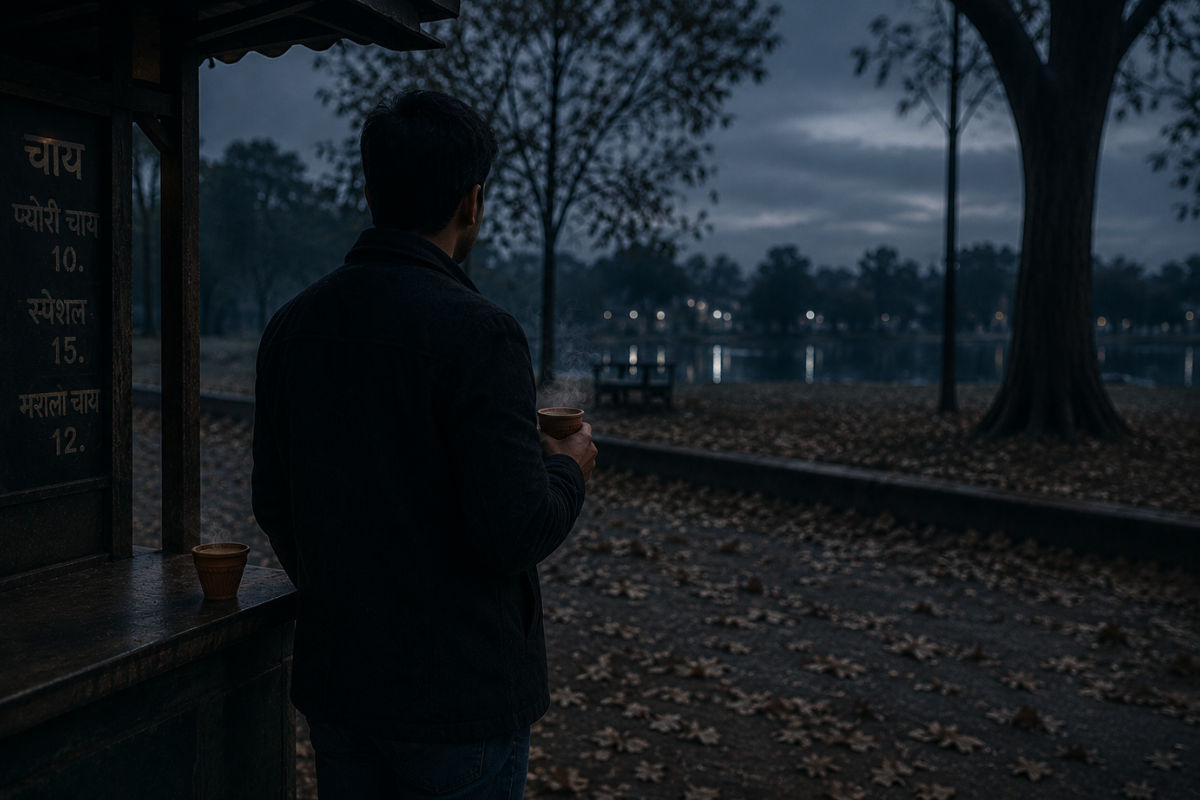
They were not the kind of couple that performed their relationship. No excessive posting, no grand gestures. They met when they could — walked in the park near her flat, shared tea at a small stall outside its gates, talked for hours about everything and nothing.
They fought too. Once, badly.
It was over something small that became something large the way those fights do — she had made plans for a Sunday without telling him, and he had already told his mother she was coming for lunch. When he mentioned it she said he should have confirmed with her first. He said he thought it was understood. She said nothing is understood unless it’s said. He said she was being inflexible. She said he was being presumptuous. The call ended with neither of them saying goodbye properly.
He didn’t text that evening. Neither did she.
He lay awake at 1 AM, the flat very quiet, thinking about the particular misery of a fight with someone you care about — how it’s nothing like a fight with anyone else, how it has a different weight, how the silence on the phone feels nothing like ordinary silence.
At 1:23 she texted: I shouldn’t have called you presumptuous. That wasn’t fair.
He picked up the phone immediately. Typed: I should have asked instead of assumed. I’m sorry.
A pause. Then: We’re both bad at this.
Yes, he wrote. We’ll get better at it.
That’s very optimistic for someone who just had his first real fight.
I have good reason to be optimistic, he wrote. And then, because it was 1 AM and the guard was down: I don’t want to fight with you. I don’t want to not talk to you. Both of those things are true at the same time.
The three dots appeared. Disappeared. Appeared again.
Same, she finally wrote. Goodnight, Vivek.
Goodnight.
He set the phone down and found, to his mild surprise, that he was smiling.
They made up the next morning over a phone call that lasted two hours and resolved nothing except the one thing that mattered — that neither of them was going anywhere. She teased him about his quietness. He told her she talked enough for both of them. She threw a cushion at him the next time they met. He caught it.
He met her father again — properly this time, Sunday dinners at her flat, the old man asking careful questions and listening to the answers with full attention. He told his mother about her. His mother said she wanted to meet her. She met her. They talked for two hours in the kitchen while Vivek and his brother sat in the next room pretending not to listen.
“She’s good,” his mother said afterward, privately, in the way she said things she meant deeply. Just those two words. Vivek understood.
The engagement was a quiet ceremony — family only, a Sunday afternoon. Isha wore a blue blazer and pants. From the entrance of the hall, before she saw him, he watched people around him look at her with uncertain expressions, whispering to each other. He walked over and stood beside her and the whispering stopped, or at least became irrelevant.
He put the ring on her finger and looked up and saw the exact moment her composure cracked — just for a second, her eyes bright and full — before she pulled it back together and smiled at him with the particular smile she had that she only showed him, slightly lopsided, slightly disbelieving, like she still found it mildly surprising that any of this was real.
Me too, he thought.
The wedding was set for two months away.
The last ordinary evening was a Saturday.
They had walked in the park — two rounds, the autumn air carrying the first real chill of the season. She had been talking about something at work, a colleague she was frustrated with, and he had been mostly listening with the ease of someone who knows they don’t need to fix everything, just be present. At the tea stall outside the park gate, the owner — who knew them by now — had their order ready before they asked.
“He knows us,” Isha said, delighted, as if this were a significant achievement.
“We come every week,” Vivek said.
“Still. It means something.” She wrapped both hands around the clay cup. “I like that there are places where we’re known.“
He looked at her in the evening light — the boy-cut hair, the slight tilt of her chin, the clay cup, the park behind her still full of families and children and the ordinary ongoing world.
He wanted to say something. He wasn’t sure what exactly. Something about how he had spent most of his life moving through the world like a person passing through rooms without leaving marks in them, and how this — this specific moment, this tea, this park, her hands around that cup — felt like the first room he’d ever wanted to stay in.
He didn’t say any of it, because he was not yet fluent in that language, had only just started learning it.
Instead he said: “Same time next week?”
She looked at him with the lopsided smile. “Obviously,” she said.
Sunday morning. 7:43.
The newspaper.
The headline.
Her photograph, small and grainy, the slight upward tilt of her chin.
He drove to her flat without fully deciding to. He stood outside the door and heard voices inside and then knocked and then the door opened and the neighbor — the older woman from the floor above who Isha had mentioned once, who sometimes kept her father company — looked at him and knew immediately from his face that he already knew.
She was wrapped in white cloth on the floor of the main room, the way he had seen in films and had never thought he would see in a room he had sat in, eaten in, laughed in. Her father sat beside her, very still, his hands folded in his lap, looking at his daughter with the expression of a man who has already used up all the grief he has and is now simply present.
Vivek sat down on the floor beside him.
He didn’t say anything. There was nothing to say.
The old man reached over after a while and placed his hand on Vivek’s without looking at him. They sat there together in the quiet flat while the city continued outside, indifferent and ongoing.
He drove her father to the village a week later. A seven-hour drive. They spoke very little. He stayed two days, helped settle things, drove back alone.
The flat felt wrong when he returned to it. Not just empty — wrong, the way a room feels when something permanent has been removed from it and the negative space left behind is its own kind of presence.
He went through the motions. Work. Dinners with his mother. Sunday calls with his brother. He answered when people asked how he was. He was fine. He was managing. These things were true in the way that partial truths are true.
Some evenings he would pick up his phone and open their conversation — the long scroll of two years of daily texts, mundane and significant and ordinary — and stop at the last message from her.
Good night Vivek 🙂
Sent at 11:47 PM, two nights before.
Never opened on her end.
The ticks never turned blue.
He never deleted it. He didn’t think he ever would.
One Sunday in November, two months after, he found himself walking to the park.
He wasn’t sure why. His feet had simply gone there.
He stood at the tea stall. The owner looked at him — looked at just him, and understood something, the way people sometimes do when they’ve watched you enough. He didn’t say anything. He just made two cups.
Vivek paid for both.
He set one on the small wooden ledge beside him and drank the other slowly, watching the park — families, children, a couple walking a dog, the ordinary world doing what it does.
The second cup sat beside him, cooling in the autumn air.
He finished his own. Left hers where it was.
People ask sometimes, not unkindly, when he’ll move on. He never knows how to answer that. Moving on suggests direction, a destination, something being left behind. What he has instead is this: a life that continues, days that are sometimes good and sometimes hard, a park he still visits on Sundays, a father he calls once a month in a village in Haryana.
And the knowledge — settled in him now, permanent as scar tissue — that love is not only the time it lasts. It is also the shape it leaves behind. The space it carves out in you that nothing else is quite the right size to fill.
Isha had asked him once, in that restaurant, what he thought love actually was. Not the Bollywood version, she’d said. The real version.
He hadn’t had an answer then.
He has one now.
It’s the moment you stop being afraid of the silence because someone else is in it with you.
She was in his silence for two years.
She still is.
Some things don’t end.
They just change their shape.
The last message on his phone still shows unread. The ticks never turned blue.
He checks it sometimes. Not out of grief — or not only that. Out of the same reason you keep a photograph. To remind yourself that something was real. That you were not alone in it. That it mattered.
It did.
It does.
“This story originated from an idea by the author and was expanded with AI assistance, followed by personal refinement and editing.”
READER RESPONSES
If this essay sparked a thought, share it.